
Identity / Zero Trust / IAM Architecture
Zero Trust IAM Architecture: Identity and Access Management for Modern Security Design
Zero Trust IAM architecture uses identity and access management as the control layer for verifying users, governing access, reducing excessive privilege, and enforcing trust decisions across cloud, SaaS, privileged access, third-party access, and workload identities.
This guide explains how Zero Trust connects with IAM architecture, identity governance, access control, privileged access management, architecture diagrams, and reference models for modern security teams.
Quick answer
What is Zero Trust identity and access management?
Zero Trust identity and access management is the approach of using identity, access policy, authentication, privilege control, lifecycle governance, and monitoring to decide whether access should be granted, challenged, limited, or denied. Instead of trusting users because they are “inside” the network, Zero Trust IAM evaluates who is requesting access, what they need, what context applies, and whether the request should be trusted.
Why IAM is central to Zero Trust architecture
Zero Trust is often described as a security architecture model, but it cannot work properly without strong identity and access management. In modern environments, users, administrators, service accounts, APIs, third parties, cloud workloads, SaaS platforms, and devices all create access paths. IAM is the layer that helps decide which of those access paths should be trusted.
A strong Zero Trust IAM model helps security teams answer six practical questions before access is granted.
Who is requesting access?
The user, administrator, workload, API, service account, or third-party identity must be known and verified.
What are they accessing?
Applications, systems, data, cloud platforms, admin consoles, and sensitive workflows need different levels of control.
Why do they need it?
Access should be linked to role, task, business function, approved entitlement, or justified operational need.
What conditions apply?
Device state, location, session context, user risk, privilege level, and data sensitivity should influence the decision.
How is access enforced?
Authentication, MFA, conditional access, access reviews, privileged access controls, and monitoring make policy enforceable.
Can it be reviewed later?
Identity decisions should be logged, explainable, auditable, and reviewed over time.
Core Zero Trust IAM architecture principles
Identity and access management architecture gives organisations a structured way to manage access, privilege, accountability, and trust. These principles support both Zero Trust design and practical security governance.
Explicit verification
Trust decisions should be based on identity, device, risk, resource sensitivity, session context, and policy signals rather than assumptions.
Least privilege
Users, administrators, applications, and workloads should only receive the access needed for their approved role or task.
Lifecycle control
Joiner, mover, and leaver changes should be reflected quickly so access does not drift beyond current business need.
Policy-driven access
Access decisions should be governed by clear policy logic rather than inconsistent manual judgement or unmanaged exceptions.
Privileged access isolation
Administrative access should be separated, monitored, approved, time-limited, and reviewed more rigorously than standard access.
Auditability
Teams should be able to explain who has access, why they have it, who approved it, when it was used, and when it was last reviewed.
Zero Trust IAM architecture diagram examples
IAM architecture diagrams help translate Zero Trust principles into practical design. They show how identity providers, access policies, privileged access controls, cloud services, monitoring, governance workflows, and trust boundaries work together.
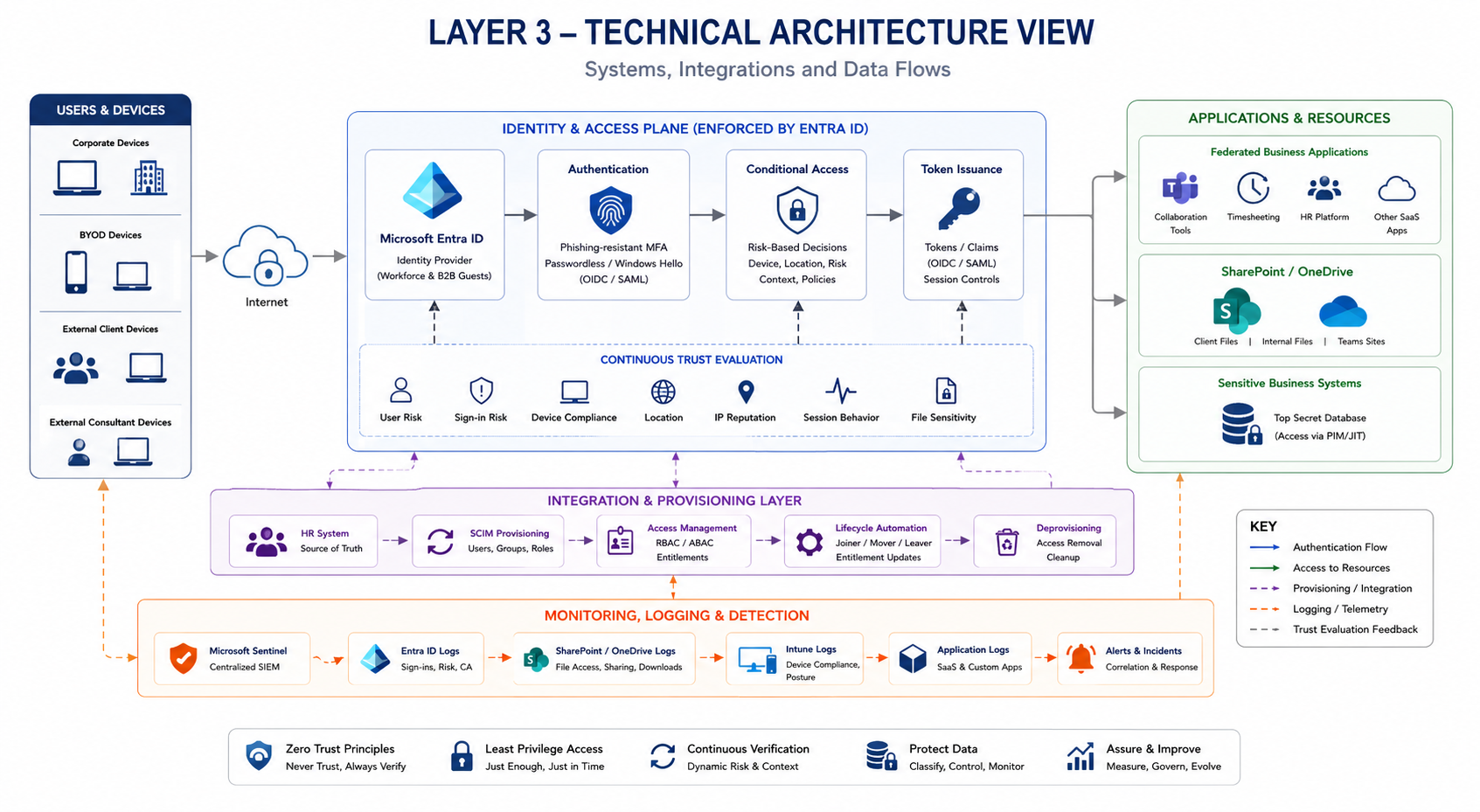
Architecture diagram
Identity-Centric Zero Trust Architecture for Cloud Consultancies
A practical architecture scenario showing how identity, conditional access, privileged access, cloud services, and monitoring work together in a Zero Trust model.
View diagram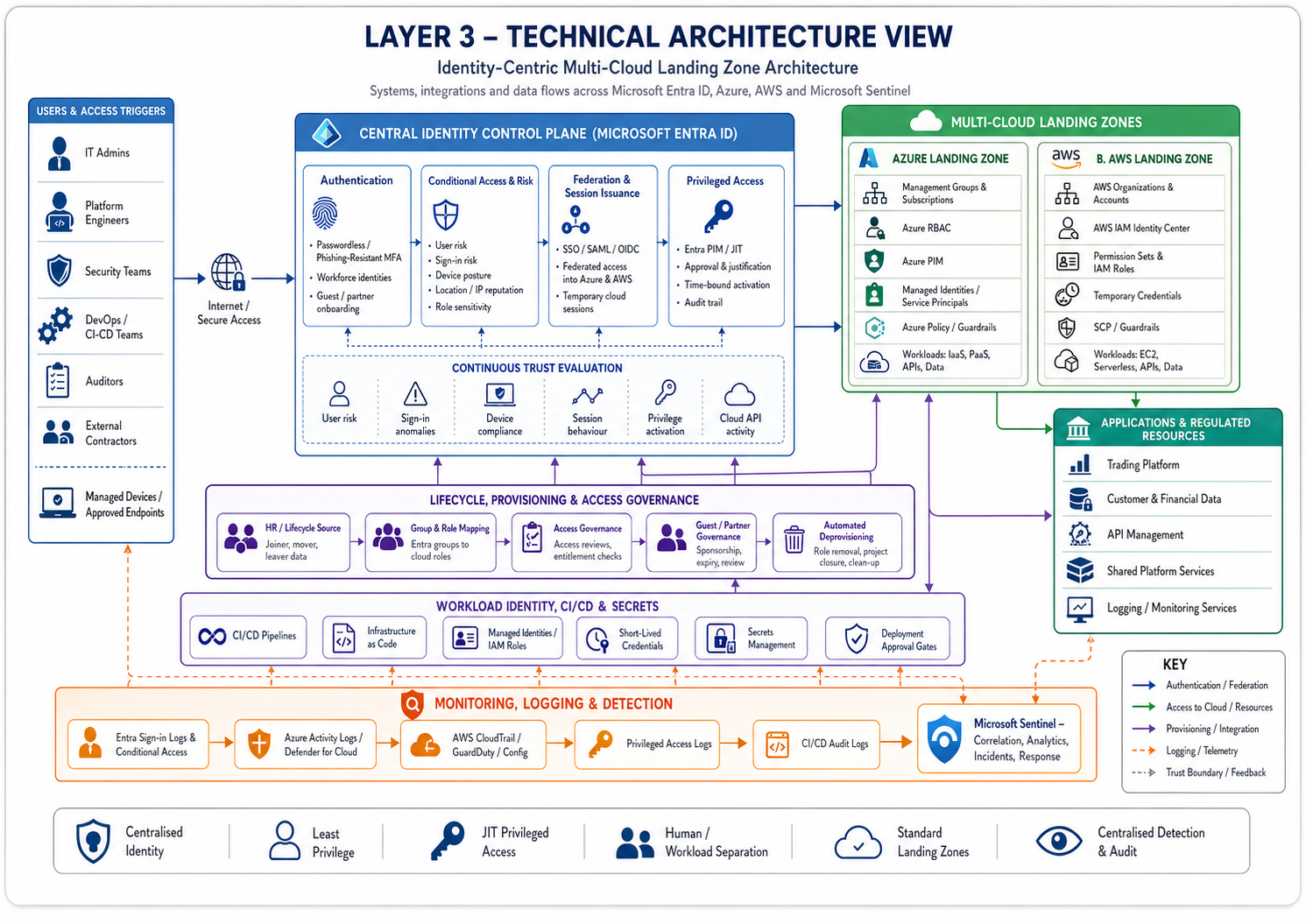
Reference architecture
Identity-Centric Multi-Cloud Landing Zone Architecture
A regulated fintech reference architecture showing how Entra ID, Azure, AWS, privileged access, workload identity, landing zone governance, and Sentinel connect.
View reference modelModern IAM reference architecture components
A modern IAM reference architecture usually combines identity providers, authentication controls, access policy engines, governance workflows, privileged access management, workload identities, and monitoring. The goal is to make access decisions consistent, explainable, and enforceable across users, devices, applications, cloud platforms, and sensitive data.
| IAM component | Role in Zero Trust architecture |
|---|---|
| Identity provider | Authenticates users, connects applications, manages accounts, and supports federation across systems. |
| Authentication and MFA | Verifies the user before access is granted, with stronger checks for higher-risk access paths. |
| Conditional access | Evaluates signals such as user risk, device state, location, session context, and application sensitivity. |
| Identity governance | Manages lifecycle, access reviews, approvals, entitlement ownership, and joiner-mover-leaver controls. |
| Privileged access management | Controls high-impact administrator access, privileged sessions, elevated permissions, and sensitive actions. |
| Workload identities | Governs service accounts, managed identities, API identities, automation identities, certificates, and secrets. |
| Monitoring and logging | Provides visibility over sign-ins, access changes, privilege use, policy exceptions, and identity-related anomalies. |
| Access model design | Defines how RBAC, ABAC, PBAC, groups, roles, attributes, policies, and entitlements are structured. |
Identity governance in a Zero Trust model
Identity governance is one of the practical foundations of Zero Trust. Without lifecycle control, role clarity, access ownership, access review, and visibility over entitlement drift, Zero Trust becomes difficult to sustain.
A Zero Trust IAM model can only enforce good policy if identity data and access ownership are clean enough to support good decisions. If users keep access after changing role, third parties remain active after contracts end, or privileged access is not reviewed, the architecture creates hidden risk even when authentication controls appear strong.
Quick verdict
Authentication proves who someone is. Identity governance proves whether their access still makes sense.
- Lifecycle control: access should change when people join, move, or leave the organisation.
- Entitlement visibility: teams should understand what access exists, where it exists, and who owns it.
- Access reviews: business owners should regularly confirm whether access is still required.
- Role governance: access models should be reviewed so roles do not become too broad or outdated.
- Third-party governance: external users should have clear ownership, expiry, review, and monitoring.
- Privileged governance: high-impact access should be approved, isolated, monitored, and periodically challenged.
Common IAM architecture risks
IAM architecture becomes difficult to govern when access grows faster than the controls around it. In many organisations, the risk is not one missing tool. It is a weak operating model around identity, privilege, ownership, and review.
Access sprawl
Users keep permissions they no longer need, especially after internal moves or temporary project access.
Weak lifecycle control
Joiner, mover, and leaver changes are not reflected quickly enough in access permissions.
Excessive privilege
Users, administrators, and service accounts have more access than their role requires.
Unmanaged workload identities
Service accounts, API credentials, automation identities, and secrets are not governed like human identities.
Inconsistent access policy
Access rules differ across applications, clouds, departments, or business units.
Poor auditability
Teams cannot clearly explain who has access, why they have it, who approved it, and when it was last reviewed.
How to strengthen IAM architecture for Zero Trust
Strengthening IAM for Zero Trust starts with making identity decisions more governed, contextual, and reviewable. The aim is not to add friction everywhere. The aim is to apply the right level of control based on risk, privilege, data sensitivity, and business context.
- Map critical access paths. Identify critical applications, privileged roles, sensitive data, third-party users, workload identities, service accounts, cloud platforms, and admin consoles.
- Define ownership. Assign ownership for identities, applications, groups, roles, entitlements, approvals, exceptions, and access reviews.
- Strengthen authentication. Apply stronger authentication and conditional access to high-risk users, sensitive systems, privileged access, and unusual contexts.
- Reduce standing privilege. Use just-in-time access, time-bound access, approval workflows, and privileged access management for high-impact permissions.
- Review access regularly. Prioritise privileged users, third parties, executives, finance teams, customer data access, cloud administrators, and high-impact roles.
- Separate human and workload identities. Govern service accounts, managed identities, API identities, secrets, certificates, and automation identities explicitly.
- Monitor identity risk. Track sign-ins, access changes, privilege use, policy exceptions, anomalous behaviour, and access review outcomes.
- Document the architecture. Use IAM architecture diagrams to clarify trust boundaries, access flows, control points, and monitoring responsibilities.
Featured IAM and Zero Trust resources
IAM architecture review
Need to review your Zero Trust IAM architecture?
If your organisation is growing, moving into cloud, preparing for audits, or trying to reduce access risk, a structured IAM architecture review can help clarify where identity, access, privilege, governance, and monitoring need stronger controls.
Frequently asked questions
These FAQs answer the common questions behind searches for Zero Trust IAM, IAM architecture, identity governance, and identity and access management architecture diagrams.
What is Zero Trust IAM architecture?
Zero Trust IAM architecture is the design approach that uses identity and access management to verify users, govern access, limit privilege, apply policy, and continuously review trust decisions across modern systems.
How does IAM support Zero Trust?
IAM supports Zero Trust by helping organisations verify identities, manage access precisely, reduce excessive privilege, govern lifecycle changes, monitor access behaviour, and apply consistent policy to trust decisions.
What should be included in an identity and access management architecture?
An IAM architecture usually includes an identity provider, authentication controls, MFA, conditional access, identity governance, access reviews, privileged access management, workload identity controls, monitoring, and logging.
What is an IAM architecture diagram used for?
An IAM architecture diagram shows how identities, applications, access policies, privileged access controls, cloud services, monitoring tools, governance workflows, and trust boundaries connect. It helps teams explain how access is governed and enforced.
What are identity and access management architecture principles?
Common IAM architecture principles include explicit verification, least privilege, lifecycle control, policy-driven access, privileged access isolation, auditability, operational maintainability, and continuous review.
Why is identity governance important in Zero Trust?
Identity governance helps keep Zero Trust practical by reducing privilege creep, improving lifecycle control, supporting access reviews, clarifying entitlement ownership, and keeping roles aligned with current business need.
What is the difference between IAM architecture and Zero Trust architecture?
IAM architecture focuses on identity, access, authentication, authorisation, governance, and privilege. Zero Trust architecture is broader, but IAM is one of its core control layers because identity often determines whether access should be trusted, challenged, limited, or denied.
What are the main risks in modern IAM architecture?
Common risks include access sprawl, weak lifecycle control, excessive privilege, unmanaged third-party access, poorly governed workload identities, inconsistent access policy, weak monitoring, and limited auditability.